The Zodiac Signs as Book Genres
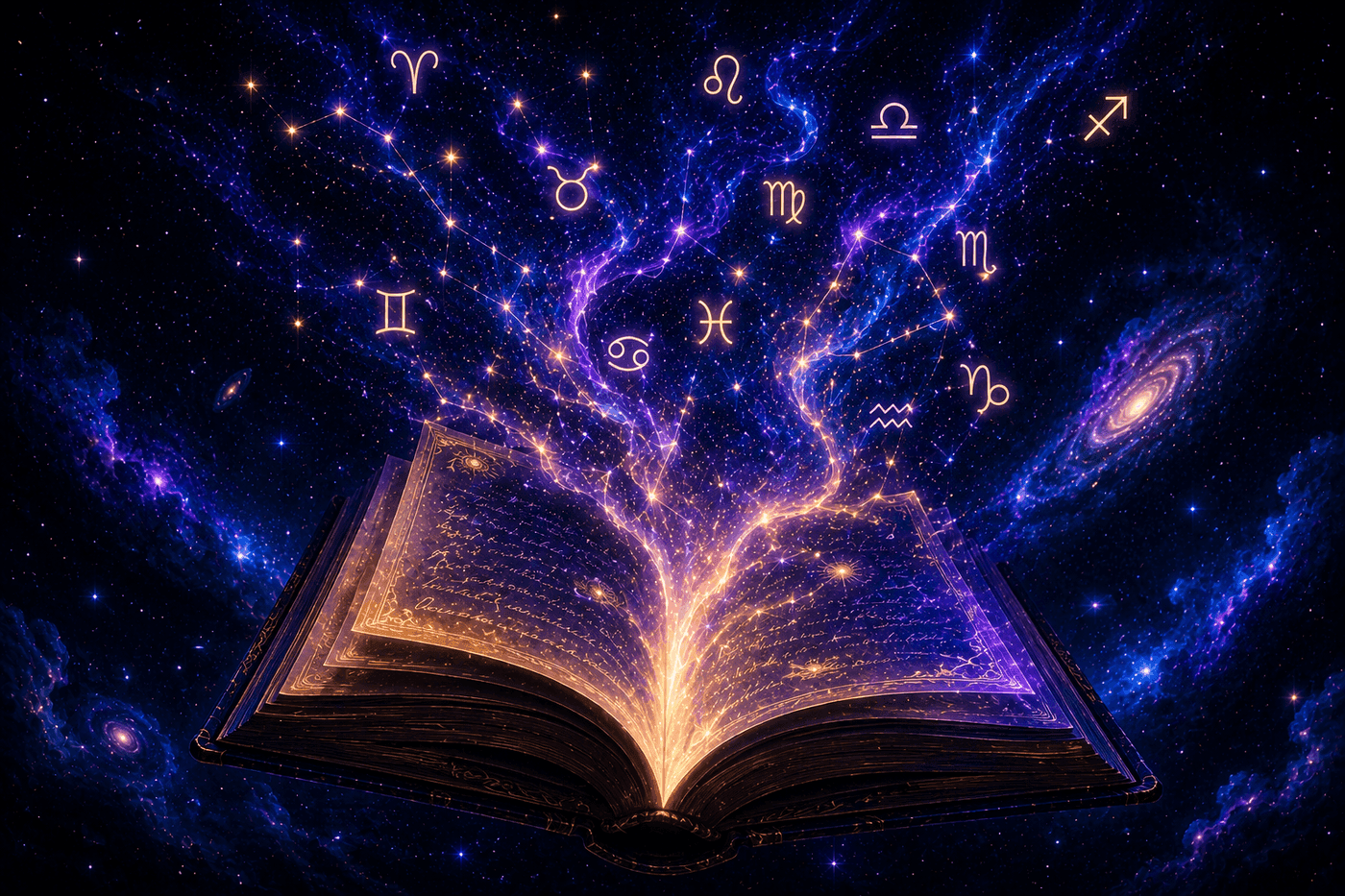
Every zodiac sign is a book waiting to be written — and more specifically, a genre with a distinct set of conventions, a target reader, and a specific emotional experience it's designed to produce. The genre isn't just what you read, it's the narrative architecture of how you move through the world: the pacing, the stakes, the kind of ending you're working toward, and what you want the person who experienced your story to feel when they close the cover. Your sign has a genre. It's been yours the whole time. Here's which one.
This isn't about what your sign likes to read — it's about what genre your sign IS. The structural DNA, the emotional register, the kind of story that only works because of the specific way your sign moves through conflict, connection, and resolution. Find yours below and send it to the person who understands the reference.
♈ Aries — Action Thriller
Aries is the genre where things happen immediately and keep happening at a pace that doesn't allow for extended reflection. The action thriller opens in the middle of something and never fully stops — there are brief moments of character development, usually delivered mid-chase, and the plot moves by consequence rather than deliberation. Aries as a genre doesn't waste pages on setup: the inciting incident is on page one, the stakes are established by page three, and the reader is committed before they've had time to decide whether they want to be. The ending is decisive. The resolution is earned through action rather than conversation. There may be a sequel. Aries is already plotting it.
♉ Taurus — Slow-Burn Literary Fiction With Exceptional Food Descriptions
Taurus is the genre that takes its time and is right to do so. The literary fiction that doesn't rush the plot because the point isn't the plot — it's the texture of the life being depicted, the quality of the light in a specific scene, the meal that takes three pages to describe because the meal matters. Taurus as a genre rewards readers who can inhabit a moment rather than waiting for the next one, who find the sensory detail of a well-rendered Tuesday afternoon as compelling as a dramatic reveal. The conflict arrives slowly and is resolved slowly and the resolution feels earned in a way that faster genres can't replicate. The food is always described specifically and always makes the reader hungry. This is intentional.
♊ Gemini — Essay Anthology With No Consistent Theme That Somehow Works
Gemini is the essay collection that covers seventeen different subjects with the same voice and makes the variety feel like coherence rather than chaos. The reader opens expecting a through-line and discovers that the through-line is the mind producing the essays — curious, fast-moving, equally passionate about completely unrelated things, capable of making connections between subjects that had no business being adjacent and being right about the connection. Gemini as a genre is the one where the table of contents looks like a personality test. The essays on opposite ends of the collection were clearly written by the same person. That person is impossible to fully categorize. The anthology is their natural form.
♋ Cancer — Multigenerational Family Saga
Cancer is the genre where memory is the architecture and love is the engine and loss is the recurring weather system that everything else navigates around. The multigenerational family saga requires a specific kind of reader — one who can hold multiple timelines simultaneously, who cares about the past as much as the present, who understands that what happened to the grandmother shapes what's possible for the granddaughter in ways neither of them can fully articulate. Cancer as a genre contains the full emotional range but circles back to the domestic, the familial, the specific weight of being someone's person and all the tenderness and grief that entails. The reader cries at least twice. The ending is bittersweet. This was always going to be the ending.
✨ Every genre exists because a specific kind of reader needed a specific kind of story — a particular emotional experience that no other format could deliver. Your sign's genre isn't random. It's the narrative form that matches your frequency exactly. The right reader for your story already knows they need it. They just haven't found it yet. ✨
♌ Leo — Sweeping Historical Epic With a Magnificent Protagonist
Leo is the genre that operates at scale — the historical epic where the protagonist's personal story is inseparable from the larger movements of history, where individual choices have consequence beyond the individual, and where the reader is never in doubt about whose story this is. Leo as a genre doesn't traffic in ambiguity about the central character — they're magnetic, flawed in ways that are interesting rather than diminishing, and capable of the kind of grand gesture that makes the reader want to stand up and clap. The prose has weight. The settings are rendered in full. The ending is earned and it is enormous. The reader finishes and sits with it for a moment before putting the book down. Leo wrote that pause into the final page intentionally.
♍ Virgo — Investigative Nonfiction
Virgo is the genre where the research is the story — the deep-dive nonfiction that follows a question to its answer through primary sources, expert interviews, documented evidence, and a commitment to accuracy that other forms of writing treat as optional. Virgo as a genre doesn't speculate where it can verify and doesn't generalize where it can be specific. The footnotes are extensive. The bibliography is impeccable. The argument built across the chapters is so carefully constructed that by the final page the reader cannot find a flaw in it because there isn't one — Virgo anticipated the counterarguments and addressed them in chapter four. The reader finishes knowing something true that they didn't know before. This was always the point.
♎ Libra — Romantic Fiction With Exceptionally Good Dialogue
Libra is the genre where the relationship is the plot and the dialogue is where the real story lives. Not the will-they-won't-they tension specifically — the verbal dance between two people who are simultaneously attracted and guarded, the conversation that reveals character faster than any amount of internal monologue, the specific way two people talk to each other that makes the reader understand exactly what the connection is before either character has named it. Libra as a genre is visually beautiful — the settings are rendered with aesthetic intention — and emotionally precise in a way that makes the reader feel like they're watching something real rather than constructed. The ending is satisfying. Both people get there. The journey was worth every page.
♏ Scorpio — Psychological Thriller
Scorpio is the genre and everyone already knew before they read the heading. The psychological thriller operates on the principle that the most dangerous things are the ones happening beneath the surface — that people contain multitudes, that trust is a calculated risk, that the most compelling mystery is always a human one. Scorpio as a genre doesn't explain itself readily. The reader is given information on a need-to-know basis, the reliability of the narrator is always a live question, and the moment of revelation recontextualizes everything that came before it in a way that makes the reader need to go back and check. The ending is satisfying but not comfortable. Scorpio doesn't do comfortable endings. Comfortable endings aren't honest about how things resolve.
The best psychological thrillers — the Scorpio genre at its finest — are the ones where you understand the antagonist by the end. Not excuse them. Understand them. Scorpio insists on this. A villain with no interior logic is a failure of imagination. Scorpio has never failed at imagination.
♐ Sagittarius — Travel Memoir That Becomes Something Larger
Sagittarius is the genre that starts as a description of somewhere and becomes an inquiry into how going somewhere changes the person who went. The travel memoir in its Sagittarius form isn't a guidebook — it's a philosophical document that uses geography as its organizing principle and uses the journey to ask questions the author couldn't have asked without leaving. Sagittarius as a genre covers a lot of physical distance and even more interior territory, the chapters moving between continents and between states of understanding with the same easy fluency. The reader finishes wanting to go somewhere. More specifically, they finish wanting to be the kind of person who goes somewhere and comes back knowing something new. Sagittarius wrote that desire into every chapter on purpose.
♑ Capricorn — Biography of Someone Who Built Something That Lasted
Capricorn is the genre where the subject's life is the argument — where watching someone build something of lasting significance through sustained effort, strategic thinking, and an uncompromising commitment to quality makes the reader understand something about what achievement actually requires versus what it looks like from the outside. Capricorn as a genre is not hagiography — the flaws of the subject are present and examined, because the point isn't that they were perfect but that they were persistent in a way that produced something real. The pacing is deliberate. The payoff is structural rather than dramatic. The reader finishes with a different relationship to their own ambitions. Capricorn wrote it that way. The genre always does its work quietly.
♒ Aquarius — Speculative Fiction That's Actually About Right Now
Aquarius is the genre where the future or the alternate present is a lens for examining the actual present with a clarity that direct examination doesn't achieve. The speculative fiction that uses its invented world to ask questions about consciousness, power, systems, and what it means to be human in a way that would be too confrontational if set in the current moment but lands with full force through the displacement. Aquarius as a genre is intellectually demanding in the best sense — it assumes the reader can follow an idea across multiple registers simultaneously and rewards them for doing so. The concepts are doing work. The characters are doing work. The world-building is doing the most work of all. The reader closes the book thinking differently about something they thought they understood. Aquarius considers this the minimum acceptable outcome.
♓ Pisces — Magical Realism
Pisces is the genre where the boundary between the real and the impossible is not a wall but a membrane — permeable, shimmering, and not always where you expect it to be. Magical realism as a genre takes the specific texture of ordinary life and allows the extraordinary to exist within it without explanation or apology, because Pisces understands that the extraordinary doesn't require permission to be present. The grief is real. The ghost is also real. Both are treated with equal seriousness because in the world Pisces builds, the distinction between them is less important than what they both reveal about love and loss and the specific ways humans try to hold onto things that are already leaving. The prose is beautiful. The reader isn't always sure what just happened. They know exactly how it made them feel. For Pisces, that was always the whole point.
Want more cosmic guidance?
Check Your Daily Horoscope